Indian IT stocks saw a steep crash on Wednesday, mirroring a sharp selloff on Wall Street, raising questions about the future of the software industry in the Artificial Intelligence (AI) age. The Nifty IT index plunged nearly 6%, the biggest single-day fall since Covid, when it slid 9.6% on March 23, 2020. All 10 constituents of the sectoral index ended lower. Big names such as TCS, Infosys, Wipro and HCL Technologies nosedived 4-7%.
The trigger seems to have come from an unexpected source: Anthropic, a San Francisco-based AI start-up, launched a suite of workplace automation tools that can perform tasks previously handled by workers or traditional software platforms. The announcement sent shockwaves through global technology markets, crystallising a fear that has been building for months — that AI might not just assist software companies, but potentially replace them altogether.
Anthropic recently launched 11 new plug-ins for its Claude Cowork agent, designed to automate tasks across legal, sales, marketing and data analysis functions. What spooked investors was a fundamental shift in how these AI agents work: Claude agents can now directly perform tasks that previously required interfaces from platforms like Salesforce or ServiceNow.
Investment bank Jefferies termed the episode as a “SaaSpocalypse,” a reference to Software-as-a-Service (SaaS) companies facing potential obsolescence.
On Wall Street, the damage was widespread. The S&P 500 fell 0.84% and the Nasdaq Composite shed 1.43%. Tech giants weren’t spared: Microsoft and Meta Platforms were both down more than 2%, while Nvidia slumped nearly 3%. Software stocks continued their 2026 tumble, with ServiceNow and Salesforce falling close to 7% each. Indian IT firms have historically tracked the Nasdaq, which mostly consists of technology stocks, especially when there is a sharp movement in the US-listed index.
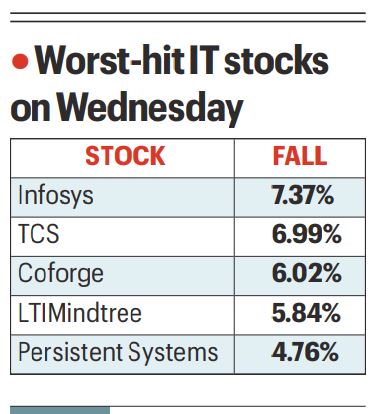
For Indian IT companies, the implications are particularly acute. Their business model has long depended on providing services — data processing, contract analysis, compliance monitoring, customer support — that AI tools can now potentially automate. Anthropic’s announcement includes specialised tools for legal workflows such as contract review, NDA analysis, and compliance monitoring, as well as applications in finance, sales and data analytics.
“To be very honest, it is very difficult to gauge the exact impact that this (Anthropic AI) will have on the Indian IT firms since none of them have commented yet. However, this seems like a knee-jerk reaction, tracking the fall in the Nasdaq,” said Sunny Agrawal, head of research at SBICAPS Securities.
Story continues below this ad
According to US-based analysts, investors are understandably worried about the potential disruption. If companies can rely on one AI assistant to review contracts, flag risks, generate reports and summarise data, investors wonder why clients should continue paying for multiple high-priced software subscriptions. The result was a sharp sell-off in software and tech-enabled professional services stocks, as markets reassessed future revenues in a world where AI could compress entire software categories into a single layer. ADRs of Infosys plummeted by 5.56 per cent on Nasdaq.
Behind the fall
The crash in Indian IT stocks was triggered by Anthropic’s AI automation tools. The start-up’s Claude agent can now perform tasks like contract review and data analysis directly, bypassing traditional software platforms. This sparked fears that AI might replace, rather than assist, software companies, threatening Indian IT firms’ core business.
The Economic Survey 2025-26 also pointed out the threat looming over India’s IT sector.
Since control over data and compute needed for AI is highly concentrated, it raises concerns about market power, technological dependence and the resilience of supply chains. It also raises a substantial question about the future of India’s IT sector, as firms that once relied on India’s comparative advantage to handle a bulk of their work may no longer need to do so, the Survey said. “It risks hollowing out India’s core value proposition if adaptation lags. If the country is to sustain its competitive edge in IT, a comprehensive evolution is necessary, one that takes full advantage of the potential embedded in AI development and deployment,” it added.
The selloff represents a dramatic shift in market sentiment. For the past two years, the narrative around AI was that it would enhance productivity and create new business opportunities for technology companies. Investors poured money into anything AI-related, driving valuations to historic highs. Now, though, a different story is taking hold.
Story continues below this ad
For Indian investors, the question now is whether this represents a temporary panic or a more fundamental reassessment of the IT sector’s prospects. The selloff erased billions in market value.
The irony is sharp: the very technology that these companies have been racing to adopt and offer to clients is now being questioned as a potential threat to their core business model. Indian IT firms have spent heavily on training their workforces in AI capabilities and developing AI-powered solutions for clients. But if AI agents can bypass traditional software platforms entirely, the value of that investment — and the companies themselves — becomes uncertain.
Whether this marks the beginning of a prolonged downturn or merely a moment of market anxiety remains to be seen. What’s clear is that the conversation around AI has fundamentally changed.
.