“Effective immediately, any country doing business with the Islamic Republic of Iran will pay a tariff of 25 per cent on any and all business being done with the United States of America. This order is final and conclusive,” Trump said in a post on Truth Social, without providing further details.
There was no official documentation from the White House of the policy on its website, nor information about the legal authority Trump would use to impose the tariffs, or whether they would be aimed at all of Iran’s trading partners.
While the fresh tariffs could primarily impact China, which is Iran’s largest trade partner, India, too, has had longstanding trade ties with Iran and considerable investment in Iran’s port infrastructure. However, sanctions on Iran due to its nuclear programme have already weakened trade ties with India over the years.
In New Delhi, which already faces 50 per cent US tariffs, the assessment is that India is not going to be affected much, with bilateral trade volume minimal as compared to other countries like China — it was $1.6 billion in 2024-25, and is estimated to touch $1.2 billion in 2025-26. Iran is not even among India’s top 50 trading partners.
“For India, Iran does not even figure in the top 50 global trading partners. Last year, India’s total trade with Iran was $1.6 billion, which is approximately 0.15% of India’s total trade,” said government sources. “India’s trade value with Iran is expected to further go down, given external economic factors,” the sources said.
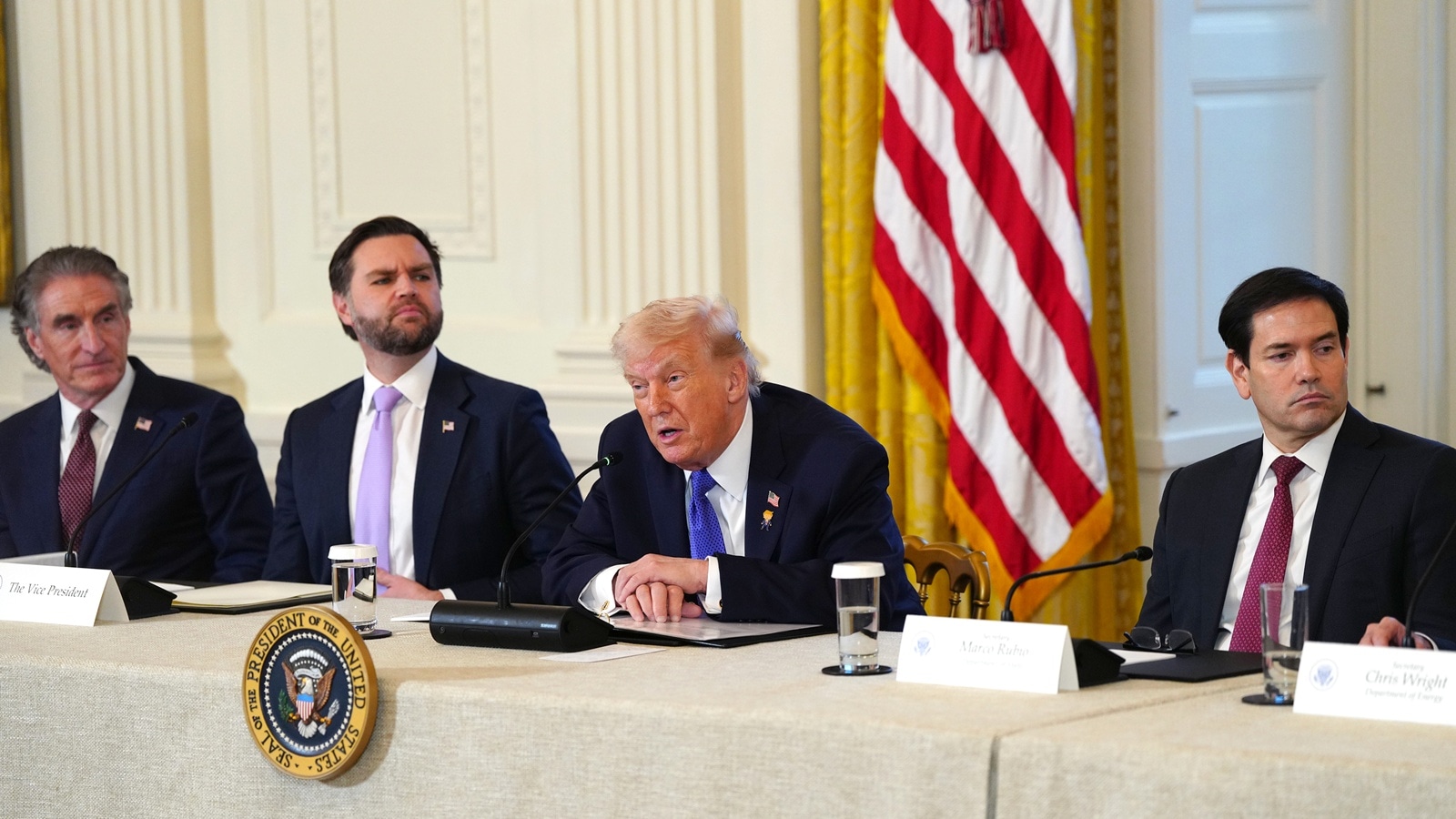 There is no official documentation from the White House of the policy on its website, nor information about the legal authority President Donald Trump would use to impose the tariffs (File photo).
In 2024, Iran’s total imports were about $68 billion, of which its leading partners were UAE ($21 billion), China ($17 billion), Turkiye ($11 billion), EU ($6 billion). India’s share was only $1.2 billion.
Story continues below this ad
However, India’s exporters of low-margin products, particularly tea and rice, are set to come under strain. Tea exporters said Iran has traditionally been a strong market for Indian orthodox tea, and the tariffs could exacerbate the restrictions that they are facing in other markets, such as Pakistan and Russia, which were once large markets for Indian tea.
Data showed that the top export items to Iran included cereals worth $757.52 million, tea, coffee, and spices worth $70 million, animal fodder worth $71 million, and fruits and nuts worth $55 million in 2024-25.
Declining trade
Official data shows that India and Iran had direct bilateral goods trade worth nearly $1.6 billion in FY25, dramatically lower compared to pre-Covid levels when the total trade stood at nearly $15 billion, largely driven by crude imports from Iran, which stopped in early FY20.
Iranian crude exports to India in FY19 stood at $12 billion, while exports also neared $4 billion in FY19. This was despite Iran being thrown out of the Society for Worldwide Interbank Financial Telecommunication (SWIFT) banking system in 2011, as both countries managed trade via a Vostro account. A Vostro account is typically maintained by a domestic bank on behalf of a foreign bank, in the domestic currency, to facilitate settlement of cross-border transactions.
Story continues below this ad
India has not imported any Iranian oil since May-June of 2019 when the sanctions waivers given by the US to India and a few other countries, allowing them to import the otherwise sanctioned Iranian crude, expired. Iran used to be India’s second-largest crude oil supplier before New Delhi significantly cut oil imports from Tehran between 2012 and 2015, amid targeted US sanctions against Iran.
Then, following the 2015 Iran nuclear deal — Joint Comprehensive Plan of Action (JCPOA) — inked between Iran and the US, UK, France, Germany, China, Russia and the European Union, international sanctions on Iran’s petroleum sector were eased. This led to Indian refiners ramping up oil imports from Iran from early 2019, and Tehran reclaimed its position as a top source of crude for India within a few months. But in 2018, the first Trump administration walked away from the JCPOA, leading to re-imposition of US sanctions on Iran, forcing India to wind down and stop imports of Iranian oil by the summer of 2019.
As the US Office of Foreign Assets Control (OFAC) imposed product-specific sanctions in 2019, India-Iran trade was further curtailed.
India’s investment in Chabahar port
Beyond trade, India has considerable investments in the Chabahar port due to its strategic importance. The port serves as the closest route to Afghanistan, Central Asia and Europe, amid strained ties with Pakistan. According to the Ministry of External Affairs (MEA), India has already supplied port equipment worth about $24 million to develop the Chabahar Port until 2024.
Story continues below this ad
In 2018, an Indian company, India Ports Global Limited, through its wholly owned subsidiary, India Ports Global Chabahar Free Zone, took over the operations of Chabahar Port, and in 2024, IPGL signed a 10-year contract with the Ports and Maritime Organisation of Iran for equipping and operating the Shahid Beheshti Terminal of Chabahar Port.
“The grant assistance for the supply of equipment has been enhanced to $120 million. India has also committed to providing a Line of Credit of $250 million in rupee equivalent for the development of Chabahar Port. Since 2018, the port has handled over 450 vessels, 1,34,082 TEUs (Twenty-foot Equivalent) of containerised cargo and more than 8.7 million tons of bulk and general cargo,” the MEA has said.
World reactions
China warned of counter measures against Trump’s decision. “There are no winners in a tariff war, and China will firmly safeguard its own legitimate and lawful rights and interests,” Chinese Foreign Ministry spokesperson Mao Ning said.
Japan and South Korea, which agreed on trade deals with the US last year, said they are closely monitoring the development. With Agencies
.