4 min readNew DelhiMar 17, 2026 08:55 PM IST
Less than 7% of male Indian graduates manage to find a permanent salaried job within a year, with the proportion being an even lower 3.7% when it comes to a white-collar job, according to Azim Premji University’s (APU) State of Working India 2026 report. The report, released on Tuesday, also said a mere 4% of males who pass the 12th standard find a permanent salaried job in the first year, with the figure being a minuscule 1.5% for white-collar jobs.
“These numbers reflect a rather worrying scenario, where even with waiting for a year, finding a secure white-collar job is an extremely rare event,” the report, titled ‘Youth in the labour market: Pathways from learning to earning’, said. This is the fifth State of Working India report published by the university. The previous edition, published in 2023, focussed on social identities and labour market outcomes.
Higher youth unemployment levels are readily visible in the government’s own monthly surveys. The latest Periodic Labour Force Survey (PLFS) report, released on Monday, showed that while the all-India unemployment rate for those aged 15 years and above edged down to 4.9% in February from 5% in January, it was almost three times as high at 14.8% for those aged 15-29 years. In January, it was 14.7%. Unemployment allowances for the youth have also been announced in recent times.
The APU report also said that while 41% of males – graduate or 12th pass – found some employment, salaried or otherwise, in less than four months, a similar proportion did not find any job even after three years, based on data from the Centre for Monitoring Indian Economy’s (CMIE) Consumer Pyramids Household Survey (CPHS). The report did not examine figures for females as the employment rates for women in the CMIE surveys were low.
Meanwhile, the report analysed data from the government’s PLFS and the erstwhile Employment Unemployment Survey (EUS) and found that graduate youth unemployment has been a “persistent problem” and stood at 39.33% in 2023, up from 35.02% in 1983, for those less than 25 years of age. Meanwhile, the unemployment rate for graduates aged 40 years and above remains very low: 0.51% in 1983 and 1.09% in 2023.
The report said there could be multiple reasons graduate unemployment is particularly high among the youth: too many graduates chasing too few jobs, waiting for the right job, and studying for competitive exams or adding to their skill sets. The report estimated, using PLFS and EUS data, that in 2023, 11 million out of 63 million graduates in the 20-29 age bracket were unemployed.
Interestingly, the difference in incomes for graduate and non-graduate youths has narrowed over the last decade. The report noted that while the gap between the two increased “substantially”, especially between 2004 and 2011, there has been a “slowdown in earnings growth for young men” since 2017.
Story continues below this ad
However, Rosa Abraham, an Associate Professor at APU and the lead author of the report, said it was premature to say that falling wage growth may be having a discouraging impact on education considering salaries for graduates are more than twice as high as for non-graduates.
“So we are not at the point that education doesn’t do anything; it doesn’t do as much as what it did earlier. It will take time to see a discouraging effect, if at all there is one,” Abraham said.
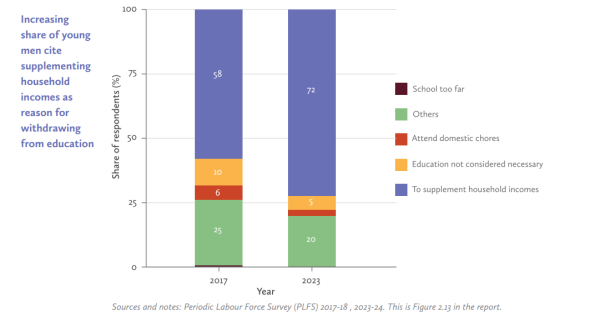
To be sure, the share of young men in education has fallen from 38% in 2017 to 34% in the last quarter of 2024, the report said, citing PLFS data. The same survey asks for the reason for non-enrollment: in 2017, 58% cited the need to support household incomes. This figure had risen to 72% in 2023.
While high graduate youth unemployment has been a constant feature in India, unemployment has become more prevalent even among the poor. In 1993, 9% of unemployed young male graduates belonged to the poorest 25% of households. By 2023, their share had risen to 16%. For women, the corresponding proportion had risen from 2% to 11%. This, the report reasoned, indicated that a rise in incomes gave families room to forego additional income from one more working member so that they could find a suitable job in line with their qualifications and aspirations.


© The Indian Express Pvt Ltd
.