Sanjay Krishnamurthi got hooked to cricket after watching Dhoni’s Dashers lift the 2011 ODI World Cup in Mumbai. In a remarkable coincidence, Sanjay made his (T20) World Cup debut 15 years later at the same venue for the USA!
The Arizona-born batter had an interesting journey, growing up in Bengaluru before returning ‘home’ at the right time as professional cricket was growing in the US. At the ICC 2026 T20 World Cup, Sanjay showed glimpses of his potential with impressive knocks against India and Namibia.
In a chat with The Hindu, Sanjay retraces his steps and the road ahead. Excerpts:
Describe the experience of playing in the World Cup in India and that first match at the Wankhede?
It was very special because the 2011 World Cup was one of the big moments for me when I really took a liking to cricket. I was very young, but I was watching that on TV. So knowing that I was coming back to that same stadium — as you walk up to the dressing room, there’s a photo of the 2011 winning team — was special.
Also, there was a big build-up to that game because, once the fixtures came out sometime in November, I knew I’d be playing India at Wankhede. But when the moment came, it was, I’d say, even more special than I thought it would be. I didn’t feel like the nerves got to me. It still felt like another game of cricket, but when I was standing on the field, you know, during the national anthems and the beginning part of the innings, until I took the catch, I was very, very nervous. Like, what if the ball comes to me?
And then I got the catch (Abhishek Sharma’s), and that was when the nerves settled. Once you play the game, it’s special. But then again, after the whole game was done, that night I went back to my hotel, and I was like, yeah, that was cool. Really special.
Let’s rewind a little. How did you get initiated into the game?
The first time I noticed cricket was probably when my dad was watching it on his laptop back in the US. That’s when I noticed it and asked him to explain the game to me. Then we came to India for a visit, and he bought me a size 0 tennis-ball bat. So I used to play a little bit with him. Tennis-ball cricket from the age of five, I’d say. And whenever I came back to India, I’d be happy to play with people.
But during the 2011 World Cup, I realised what cricket could be. Because until then, cricket to me was tennis-ball cricket with my dad. It wasn’t the scale of a World Cup! That’s when I really got excited by it. And then three months later, we moved to India. So that’s when I had the opportunity.
From the time we moved into a new apartment in Bangalore (now Bengaluru), I went downstairs and played tennis-ball cricket with the kids. About a month after moving, my dad saw that I really wanted to play cricket, so he enrolled me into a proper academy (J. Arun Kumar Cricket Academy), with a leather ball, and got the full kit and everything.
After a couple of years, we realised that school cricket is very important. So I joined a school (Ebenezer International School) to play cricket. But at the same time, I wanted to focus on my academics. It had a good cricketing culture. (Current) Karnataka (Ranji) batter R. Smaran was my classmate there, and we played together through the age groups.
Sanjay Krishnamurthi en route to his maiden T20I ton in the World Cup game against Namibia.
| Photo Credit:
AFP
What are your abiding memories of playing school cricket in Bengaluru?
In school cricket, I used to play as both a bowler and a batter. I started as a left-arm pacer, then changed to left-arm spin, along with opening the batting. I really enjoyed school cricket.
The first big thing for me was Anil Kumble’s Spin Stars. There was a statewide trial to try to get spinners. They selected the top 20 spinners based on talent from the ages of 11 to 19. I think I was the youngest one picked at 11. So I got the chance to work on my spin bowling with proper coaching. That’s when my parents also realised that I might have something a little bit special compared to others.
After that, I played for Karnataka under-14 probables. I didn’t make it into the final 15 as a spinner. Then, in my last year of under-16, I scored many runs for the school. I headed into the season still thinking I’d continue mainly as a left-arm spinner. But I scored many runs and played as a batsman for the State u-16 team.
The year after that, I didn’t get picked into the zonals either, even though I had some decent performances at the club level. That’s when we heard about the opportunity to come to the US. Since I had a US passport, I would be able to play immediately. So we went to Houston for a trial to try to get into the USA team.
We decided to make it a whole family visit, so the whole family came over. But that’s when COVID hit. So we couldn’t go back. We just settled there, and it worked out.
How did you adapt to the different training routines in the US compared to what you had in India?
The outdoor facilities, especially at that time, didn’t really have turf wickets. There was a lot of astro turf that didn’t require maintenance. The indoor facilities were quite good.
In the US, I actually got to play against some better bowlers than I would have in India — like Rusty Theron, who played for South Africa. He was bowling to me when I was 16. Also, Saurabh Netravalkar and others of good quality. So in terms of quality of bowling and training, it was right up there.
Even in games like Minor League Cricket, at 16 I was already playing men’s cricket in the US, whereas in India, you’re still in the age-group system.
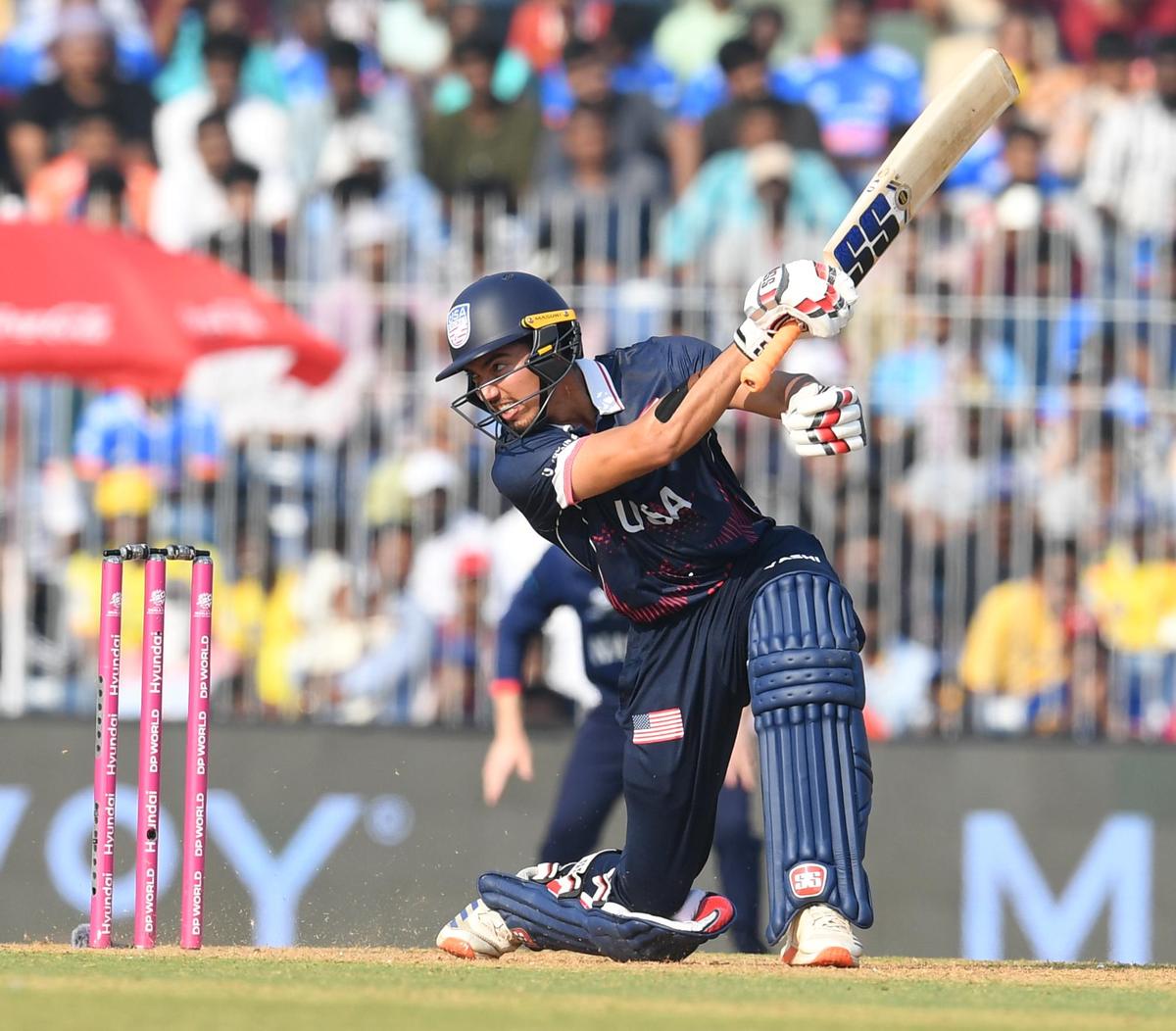
Sanjay Krishnamurthi plays a one-handed shot against Namibia.
| Photo Credit:
R. RAGU
Who were the coaches who made a big impact on your career?
Initially, it was JAK (J. Arun Kumar) sir. After that, our school coach, Syed Zabiullah Sir, was very helpful. He’s also Smaran’s coach. Then there was former Karnataka captain Kartik Jeshwant. He was the one who really helped me think about transforming my game from a defensive batter to an aggressive one.
I was a defensive batter with a very tight technique. I knew where my off stump was and all of that until I played age-grouop cricket for Karnataka. In my first year in the under-16 State team, I didn’t really make much of an impact. That’s when, during one net session on a tricky wicket that was doing a bit, he said, just go after your shots. Try to hit everything.
I smacked it in that net session. I was middling everything and hitting it hard. That’s when he saw something and told me, ‘yeah, this is you now’. Ever since then, I have transformed into a power-hitting type of batsman.
How important was it to have the early grounding in India, and how has it helped?
We played a lot of games, which helped. Also, playing mainly longer formats helped build a base. So when I need to get through a tough situation, I can always trust my defence.
To be a successful attacking, power-hitting batsman, you always have to trust your defence at the end of the day, to not get out. Age-group cricket, especially in India, is tough. Many other countries catch up from ages 19 to 23. But I’d say until the age of 19, nobody’s tougher than India.
How much of an impact has Major League Cricket had so far?
We were looking forward to Major League Cricket for a while. In the first season, I was there at the draft and saw my name. I think I was the third-last pick — fourth pick in the rookie round (Under-23 round). I was 19, and I was over the moon. I already knew that Aaron Finch and Marcus Stoinis were signed with that team (San Francisco Unicorns). In that first season, I enjoyed every moment, even though I didn’t play a single game. I worked with Shane Watson and spoke about the mental side of the game. I observed how a fully professional team is run.
I went into the off-season really motivated. I worked a lot on my fitness, the mental side of the game, and power-hitting. I headed into the next season without very high hopes of necessarily getting a game, but ready to make the best of any opportunity.
Then I found out I would be playing every game that season. That’s when I had my breakthrough. I scored 79 not out against Washington Freedom. That was when I really felt confident in myself and in my ability to do it against the best.
What were the things that Watson helped you with?
The main thing is that he gave me confidence. He didn’t tell me too much that I needed to work on. He just said to keep doing what I was doing and that I was still young and would get better.
The thing that surprised him the most was my power-hitting ability because of my frame. Back then, I was even skinnier. You don’t expect someone like that to generate the power to hit sixes. That probably impressed him.
How did you work on your power-hitting game?
I did a lot of tennis-ball practice with my dad. When we moved to California, I worked with a baseball coach. That’s where I learned some of the mechanics behind hitting powerfully and using the hips to generate more power.
There were a lot of drop drills and trying to hit sixes. Even in games, I tried to hit sixes. The more you hit sixes, the more you understand what is going to go for six and what isn’t. Then you start to figure out your own game.
Can you elaborate a bit on the baseball drills?
It’s about rotational power because cricket is a very linear game. Growing up, we are taught to play straight and with a vertical bat. That’s what helps you survive.
But to generate more power, you want to use your hips and go a little more rotationally. That’s something that’s coming into the game more now. I found it very easy to connect it. Even though in baseball they swing quite horizontally, he taught me how to generate that same force even with a fairly vertical bat.
Walk us through your knock against Namibia, your first T20I half-century and the Player-of-the-Match award?
It was special. In the previous three games, I thought I played well against India, but I didn’t get a bigger score. I wasn’t thinking about personal performances, though. Even heading into that game, it was about getting the team as many runs as possible.
As I walked in, our captain, Monank Patel, who was walking out, told me to just play my game and play freely. I went in playing freely. Any ball in my zone, I was ready to hit for six from the beginning. Off the third ball, I got one I felt I could hit for six, so I decided to go for it. When I had my match-up against the left-arm spinner and the left-arm pacer, I decided to tee off, and it came off that day.
Do you feel this tournament and what you have shown could open the door to a possible IPL deal?
Obviously, the IPL is the pinnacle of franchise cricket, so I would absolutely love to play in it someday, but I don’t think about selections too much, as they’re out of my control, so I’ll continue to take it one game at a time.
What is the road ahead for you? What are your near-term targets and the areas you will be focusing on?
I’d say a few near-term targets are to deliver match-winning performances against full member teams and play as much franchise cricket as I can across different countries, which will allow me to continue developing my game. A couple of exciting tournaments on the horizon are the 2027 ODI World Cup and the 2028 Los Angeles Olympics.