Fighter jets flew in tandem as Lord’s stirred to a morning full of anticipation, while nearby tube stations dispensed eager fans. A youngster added to the cute-quotient with a placard beseeching people to spare one ticket as he had own all the way from New Zealand. It was July 14, 2019, and the ICC World Cup had finally inched towards its climax.
Host England and doughty New Zealand were in the mix, and as the rousing summit clash yielded ties, both in the match and through the Super Over, a boundary count was used as the nail-biter. It’s never ideal, but that is the way it was as Eoin Morgan’s men found their moment under the sun while New Zealand, led by Kane Williamson, was left to mourn a tale of being so close, yet so far.
The cup that matters?
Ever since the World Cup was launched in 1975, England had flattered to deceive and, finally, thanks to Ben Stokes and the chutzpah and ability he bristles with, cricket’s birthplace finally had won the cup that matters. Or so it seemed until the post-match press-conference commenced in the Lord’s basement while the crowd outside, lubricated with a frothy liquid, was busy making merry.
Morgan, all narrow eyes, impish grin, and overwhelming relief, sauntered in with the World Cup in tow. And as eager correspondents shot up their hands, the first question was about how this triumph could boost morale for the impending Ashes against the visiting Aussies! Yes, you heard that right, an epochal universal title was deemed as a maiden step to seize what was and still is essentially a bilateral series.
The England captain with Irish veins took no offence and, in fact, answered at length. Even if that particular moment had to be present in the ‘here’ and ‘now’, and demanded that joy be multiplied through champagne bubbles, Morgan juxtaposed the win with the imminent Ashes. It seemed normal for the British journalists too as they eventually warmed up to an incredible final and a much-awaited title.
Eoin Morgan led England to its only World Cup triumph in 2019.
| Photo Credit:
FILE PHOTO: REUTERS
Being the World Cup, obviously the press corps consisted of representatives from significant countries on the cricketing globe. And for those from Asia, especially, it was an eye-opener in terms of the variable awe that a World Cup seemed to generate in different parts of the former Empire where the sun never set.
Earlier that day, inside the cramped Lord’s press-box, one of the local scribes wryly said that if England won, it would make page one, and if the host succumbed, then the reportage would be relegated to some part of the sports page. That remark, and the query in the media interaction, showed that in terms of the sports micro-culture prevalent then and now in the Old Blighty, the Ashes had a bigger brand value, or recall, as those quoting marketing guru Philip Kotler would say.
Perhaps, it is tied up with long-drawn history, as England and Australia are the original rivals in cricket, having played the first ever Test at Melbourne in 1877. The erstwhile mother country and colony still have an umbilical cord as Charles III remains the monarch. Yet, there are undercurrents of the ruler’s complacence and the distant subject’s angst even as both England and Australia are distinct independent countries.
In the mid-1980s, Ian Botham quipped about the fun of defeating 11 convicts in front of 11,000 convicts. It was a tongue-in-cheek remark, a sledge ahead of an Ashes joust Down Under, but still it had the weight of history and the vestiges of colonialism. It is common knowledge that ancient England shipped its prisoners to Australia, deemed both a colony and equally a space for housing convicts.
Probing old wounds
Botham was claiming the moral high ground, a superiority flex even if at the time of his utterance he may not have done a psychological or anthropological study of his words. But all this is part of the quirks of the Ashes, even if old historical wounds are probed with a touch of black humour.
The Ashes that came into effect from the 1882-83 series is part of sporting folklore. The urn is revered even if the British Empire may just be a memory, restricted to silver fish-gnawed pages of historical tomes placed in musty libraries. Yet, through the Ashes, it shines and wanes. England and Australia are fused through English of diverse accents and also split by cricket of combative skills and sharp words.
It is a rivalry that has the vigour and zest of Argentina against Brazil in football. That, like the cricketing one between India and Pakistan, has the twinge and pangs of neighbour’s envy. At many levels, India against Pakistan, with all the baggage stretching back to Partition in 1947 and the resultant political and religious complexities, has an edge.
But with the way things are across the Wagah, the Asian giants face o only in ICC’s multi-team tournaments while bilaterals have been avoided. This is a rivalry that has its episodes distilled into the odd limited-overs bash unlike the Ashes that endures through regular Tests.
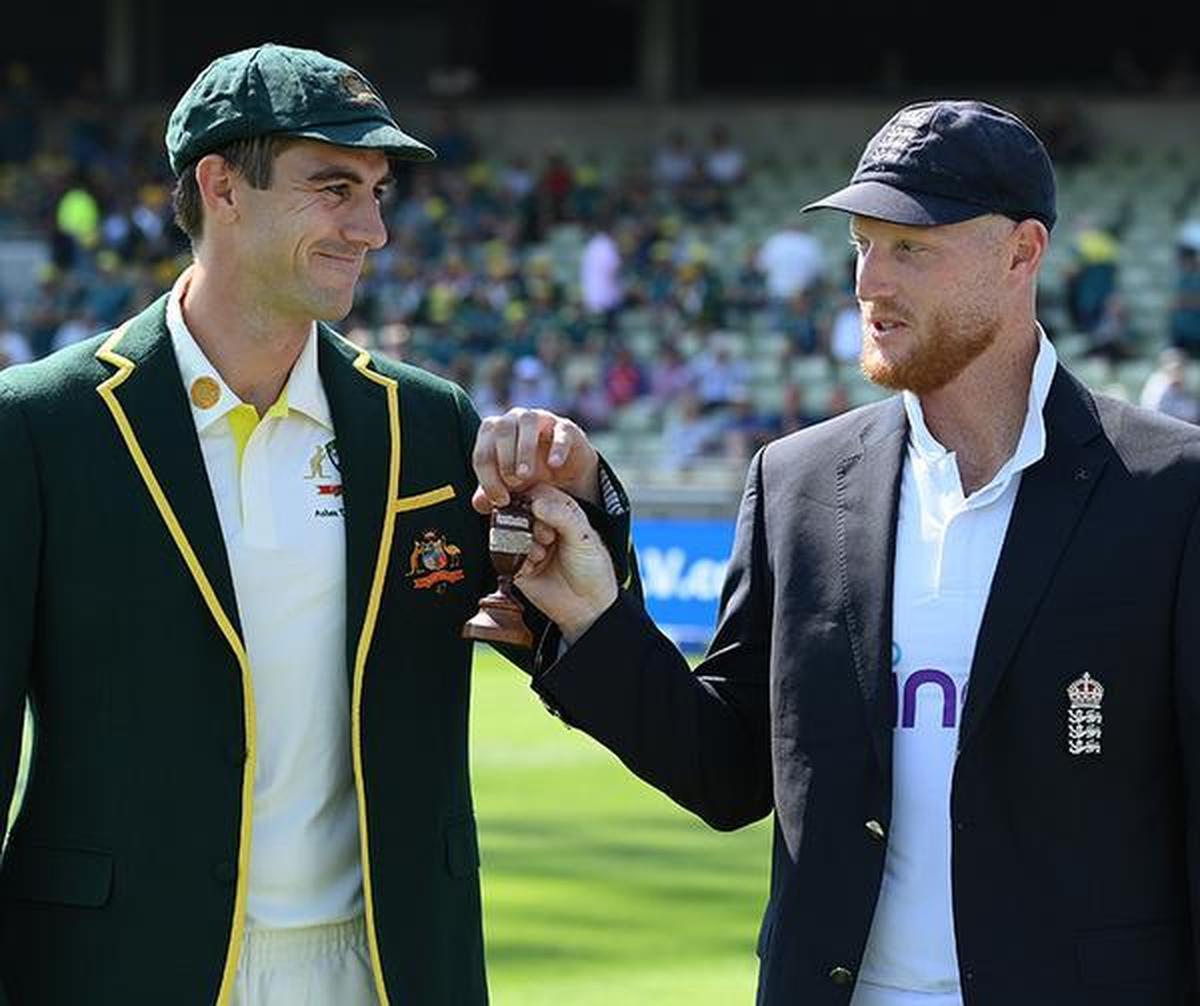
Australia captain Pat Cummins and his English counterpart Ben Stokes with the Urn.
| Photo Credit:
FILE PHOTO: GETTY IMAGES
Cut to the present, as Stokes and his men get busy in Australia, the hype machine is on overdrive and tabloids are running cheeky headlines. Joe Root is reminded of his lack of Test tons Down Under while former players on either side are busy playing Nostradamus.
A rivalry embellished by the exploits of Don Bradman, Harold Larwood, the Chappells, Dennis Lillee, the Waughs, Botham, David Gower, Allan Border, Stokes, Ricky Ponting, Shane Warne, Kevin Pietersen, Andrew Flinto and many more champions, is getting fresh air through nostalgia’s sieves. The Ashes always had its high-points, especially in 1981 and 2005, and it elevated many players, forced some into retirement, and generated enough anecdotes for former stars to shine as after-dinner speakers.
But seen from an Indian perspective, there is always that question: Aren’t the recent India-Australia skirmishes gaining more intensity and heft, especially after the Eden miracle in 2001? And hasn’t India been the better tourist over the last decade Down Under even if the last sojourn wasn’t exactly a good one?
Drawing an audience
The Ashes, though, continues to have its charms and draws an audience, both from the emotionally-invested, like viewers from England and Australia, and the neutrals like the Indians. There is buzz, wit, o- eld needle, and then the action is further alloyed with concise descriptions and pauses in commentary — at least, that used to be the norm. Think Richie Benaud. Over 345 Tests, Australia has won 142, England has prevailed in 110, and when Perth hosts the first contest of the latest Ashes from November 21, a fresh chapter will be added. As an Indian, you could mumble ‘what is the fuss’, and still be drawn towards it, just like you peer at Wimbledon with a sense of wonder. And yes, there is a slice of the sporting universe where the Ashes matters more than World Cups! Strange but true.