Strong aftershocks to a powerful earthquake that killed more than 1,400 people at the weekend rattled eastern Afghanistan on Tuesday (September 2, 2025) as survivors in remote hard-hit villages prepared for another night without shelter.
A 5.2-magnitude earthquake jolted the region near the epicentre of the magnitude 6.0 earthquake that hit late Sunday (August 31, 2025) night — one of at least six aftershocks recorded by the U.S. Geological Survey.
“These aftershocks are constant, but they have not caused any casualties yet,” Ehsanullah Ehsan, the disaster management spokesman in Kunar, told AFP.
The number of victims from Sunday’s earthquake has mounted steadily, with 1,411 people dead and 3,124 injured in Kunar alone, chief Taliban government spokesman Zabihullah Mujahid said on Tuesday (September 2, 2025), making it one of the deadliest to hit the country in decades.
Another dozen people were killed and hundreds injured in neighbouring Nangarhar province.
Rescuers are scrambling in a “race against time” to reach the mountainous and remote area devastated by Sunday’s (August 31, 2025) powerful 6.0 magnitude earthquake, a U.N. official said, warning of an exponential rise in the number of casualties.
The quake struck in several provinces, causing extensive damage. It flattened villages and trapped people under the rubble of homes that were constructed mostly of mud bricks and wood and were unable to withstand the shock. Rough terrain is hampering rescue and relief efforts.
“We cannot afford to forget the people of Afghanistan who are facing multiple crises, multiple shocks, and the resilience of the communities has been saturated,” said Indrika Ratwatte, the U.N.’s resident coordinator for Afghanistan.
Afghanistan earthquake: rescue efforts at epicentre
| Video Credit:
The Hindu
He urged the international community to step forward. “These are life and death decisions while we race against time to reach people.” It is the third major earthquake since the Taliban seized power in 2021, and the latest crisis to beset Afghanistan, which is reeling from deep cuts to aid funding, a weak economy, and millions of people forcibly returned from Iran and Pakistan.
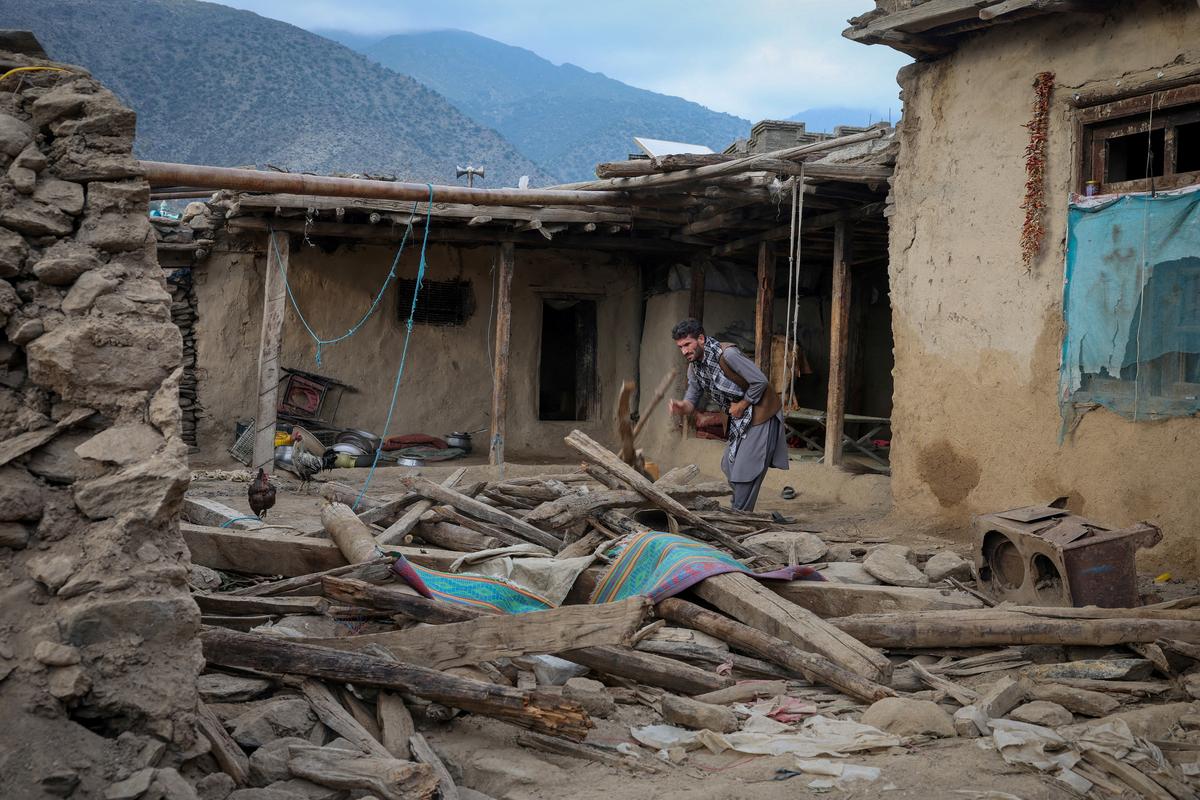
An Afghan man looks for his belongings amidst the rubble of a collapsed house after a deadly magnitude-6 earthquake that struck Afghanistan around midnight, in Dara Noor, in Jalalabad on September 1, 2025.
| Photo Credit:
Reuters
Ratwatte said that when the walls of wooden and mud homes collapse, the roof falls on to the occupants, causing injury or death. While the area was low-density, the earthquake struck when everybody was asleep.
“If you were to model it based on what has happened before, clearly there’s no question that the casualty rate is going to be rather exponential,” he said.
The Taliban government, which is only recognised by Russia, has appealed for assistance from foreign governments and the humanitarian sector.
However, help for Afghanistan is in short supply due to competing global crises and reduced aid budgets in donor countries.
There is also opposition toward the Taliban government’s restrictive policies on Afghan girls and women, including a ban on them working for nongovernmental organisations. Earlier this year, the US gutted aid money to Afghanistan, partly due to concerns that money was going to the Taliban government.
Kate Carey, who is the deputy head of the UN Office for the Coordination of Humanitarian Affairs in Afghanistan, said more than 420 health facilities had closed or were suspended due to the “massive reduction” in funding, with 80 of them in the eastern region, the heart of Sunday’s quake.
“The consequence is that the remaining facilities are overwhelmed, have insufficient supplies and personnel, and are not as close to the affected populations as the more local facilities at a time when providing emergency trauma care is needed in the first 24 to 72 hours of the earthquake response,” said Carey.
Published – September 02, 2025 12:49 pm IST
.