The Ministry of Statistics and Programme Implementation (MoSPI) will not use Unified Payments Interface (UPI) transaction data to calculate India’s GDP in the new revised series that will be released this week due to the numbers being unstable and certain payment categories being too broad.
Proposed as one of the non-traditional sources of data that could be used as an alternative indicator in the estimation of Private Final Consumption Expenditure (PFCE)– one of the key components of GDP when it is calculated from the expenditure side of economic activities– for quarterly GDP figures, a sub-committee of the statistics ministry’s Advisory Committee on National Accounts Statistics (ACNAS) has said it is too soon to use UPI transaction data.
“Transactions against clubbed items (e.g. Super markets) cannot be bifurcated into separate PFCE items, whereas, it accounts for substantial share in total transaction value and volume,” the report of the sub-committee on methodological improvement for the base revision of GDP, released last week, said.
UPI data in value (rupees) as well as volume (number of transactions) is available from the National Payments Corporation of India, with each payment categorised by the type of merchant.
The merchant code 5411, for instance, refers to ‘Grocery Stores, Supermarkets’.
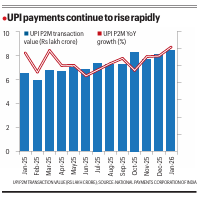 UPI transaction chart (Express Photo)
However, these UPI transactions are for a variety of goods sold in these stores. As such, data for this category — which accounted for 25% of all person-to-merchant transactions by volume and 9% by value in January — is not useful for the purpose of compiling private final consumption expenditure within GDP on an item-wise level.
Then there are some UPI payment categories that don’t have a corresponding item in private consumption expenditure, such as ‘debt collection agencies’ (merchant code 7322). While the number of UPI payments to ‘debt collection agencies’ made up just 1.4% of all person-to-merchant UPI transactions in January, the value of these payments was a sizable 7.2% of all transactions.
Story continues below this ad
The report also said that payments transaction data is not stable, with many people yet to move to UPI from cash. “Once the UPI transaction data get stabilised, it may be explored for possible inclusion as an indicator in the estimation of PFCE.”
GDP data for October-December 2025 and the second advance estimate for 2025-26 as per the new series with 2022-23 as the base year will be released on Friday, with MoSPI Secretary Saurabh Garg and Chief Economic Advisor V Anantha Nageswaran set to address the media on the same.
Estimating private consumption
MoSPI calculates GDP using two methods — production or income approach and the expenditure approach. While the production-side GDP figure is seen as being more reliable and accurate, changes in the various components of the expenditure side are crucial from a policy perspective.
One such component is PFCE, an indicator of household consumption levels, which makes up more than half of India’s GDP.
Story continues below this ad
“The PFCE methodology basically draws indicator from relevant sectors vis-a-vis items encompassed in production side. The reason is that, except for few items, High Frequency Indicators pertaining to item-level HH (household) consumption figures are not available. Therefore, growth rate observed in production estimates for an item/sector are taken as a proxy for the growth rate in PFCE for that item,” the minutes of a June 2025 meeting of the above-mentioned ACNAS sub-committee, also released last week, said.
It was in this context that the exploration of new indicators such as UPI transaction data was proposed to “capture the consumption accurately” at an item level.
As per the current GDP series with 2011-12 as the base year, PFCE estimates are released for 46 items under 12 broad categories.
In the new series, estimates for 128 PFCE items will be compiled by MoSPI, while data will be published for 49 items across 13 categories ranging from ‘food and non-alcoholic beverages’ and ‘clothing and footwear’ to ‘recreation, sport and culture’ and ‘insurance and financial services’.
Story continues below this ad
Some non-traditional indicators that will be used to help compile GDP data in the new series include Goods and Services Tax (GST) and Vahan data to calculate the number of vehicles used in compilation of PFCE of road transport services, as per the report of the ACNAS sub-committee for incorporation of new data sources, rates, and ratios for base year revision of GDP (2011-12 to 2022-23), released on Tuesday by MoSPI.
New GDP series
The last time India’s GDP series was updated was more than a decade ago, in early 2015, with the revision resulting in growth rates being raised as MoSPI also incorporated several methodological changes to measure the size of the Indian economy more accurately and comprehensively.
Such was the magnitude of the growth upgrade that Raghuram Rajan, then the Governor of the Reserve Bank of India, said the central bank found it “hard to see the economy as rollicking” in 2013-14 after the new series raised GDP growth for that year to 6.9% initially (later revised to 6.4%) from 4.7% under the previous series which had 2004-05 as the base year.
As in 2015, the current statistical revision will also involve major changes in the compilation of India’s GDP, with some key concerns flagged by economists and international agencies being addressed, including how ‘real’ GDP is calculated by adjusting ‘nominal’ GDP.
Story continues below this ad
Other areas being addressed include better measurement of the country’s latest economic structure, with e-commerce having gained prominence over the last decade, as well as the informal sector, among others.
According to economists, India’s growth momentum is likely to have remained strong in October-December 2025, after growth in the previous two quarters comfortably exceeded forecasts by coming in at 7.8% in April-June 2025 and 8.2% in July-September 2025.
The first advance estimate for 2025-26 pegged the full-year GDP growth rate at 7.4%. These numbers are as per the 2011-12 base year GDP series and will be revised when the new series is released on Friday, along with the numbers for the previous three years: 2022-23, 2023-24, and 2024-25.
“Overall, we expect Q3FY26 real GDP growth of closer to 8.1%. Given significant methodological changes, it is difficult to predict the direction of revision,” Soumya Kanti Ghosh, State Bank of India’s Group Chief Economic Adviser, said in a report on Tuesday.
Story continues below this ad
BofA Securities has forecast 7.5% as the third quarter growth rate, although it said the estimate is based on “our old trackers for the GDP data that we deployed for the series with the base year 2011-12, and the new national income estimates may have variances”.
.