A “close cooperation” between governments and AI companies will become “increasingly important over time,” Sam Altman, CEO of OpenAI, said here Friday, underlining the need to democratise the technology and build robust infrastructure. He also stressed that, given the size of India’s economy, the country should work across all layers of the AI stack: from energy and infrastructure to chips, frontier models and applications.
Altman is in India to attend the India-AI Impact Summit, where his company has announced a number of partnerships, including a data centre deal with Tata Consultancy Services and plans to open new offices in Bengaluru and Mumbai. Speaking at Express Adda, where he was in conversation with Anant Goenka, Executive Director, The Indian Express Group, Altman, arguably one of the most influential technology leaders today, spoke with candour on a range of issues reflecting both the breadth and depth of his engagement with AI and its place in the world.
From what he wouldn’t ask ChatGPT — how to be happy — to why only some children may use AI as a shortcut to do homework even as others use it to break new ground, Altman, who co-founded OpenAI in 2015, addressed key questions on AI and power, the disruptive effects of the technology, and the role of China.
Asked about the latest update on the device that OpenAI is trying to build, for which it has brought in legendary designer Jony Ive – the key architect of Apple’s design – Altman said that the company might be able to “talk about it by the end of this year.” He suggested this would be a milestone in the long arc of devices that has remained relatively unchanged.
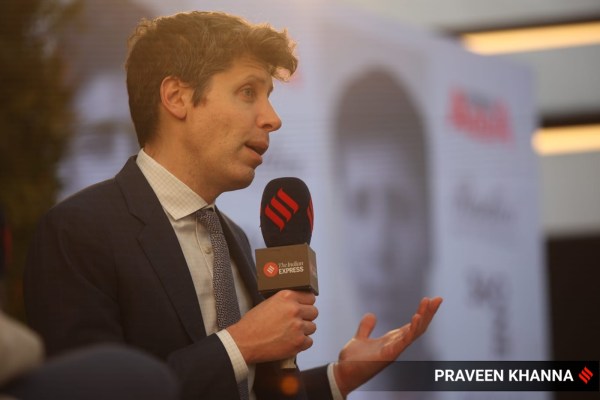 Altman, arguably one of the most influential technology leaders today, spoke with candour on a range of issues reflecting both the breadth and depth of his engagement with AI and its place in the world. (Express Photo by Praveen Khanna)
“We have basically used computers in the same way for 50 years. The work that Xerox PARC (Palo Alto Research Center) did to invent all the concepts of windows and pointing devices, everything that we now take for granted is amazing. Putting it on the phone and adding multi touch was also amazing. But, fundamentally, it’s been a similar kind of idea. And then AI came along, and AI is stuck in that same form factor. But AI is quite a different thing. You can now talk to a computer in natural language. They can do incredibly complex things for you. It can understand a huge amount of context, and the form factor of computers does not quite work for this… I want to use a piece of technology that is observing my whole life and it has all the context, and it’s maximally useful…” he said. “A new family of products that were really designed around AI, that are kind of participating in your life and not in the way of it.”
Sam Altman on close cooperation between tech and govt
Responding to a question on ties between Silicon Valley and the current US administration, Altman said, “I would say (it is) close in some ways and not close in others. There are some tight ties, and then this administration has also had some criticisms in tech. I think close cooperation between tech companies and the government is going to become increasingly important over time,” he said.
He added that such close relationships were becoming important “given the level of impact that is coming up on society (due to AI) and the need to truly democratise this technology… Governments are going to have to be involved, and companies like ours are going to have to partner governments”. He added: “AI will become one of the most important political issues in the world.”
Story continues below this ad
Asked which layers of the so-called AI stack — energy, infrastructure, chips, frontier models and applications — India should prioritise, Altman said the country should “play at all of those levels”.
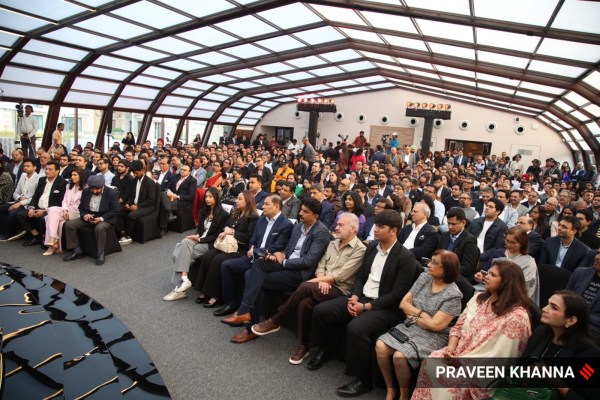 Altman, who co-founded OpenAI in 2015, addressed key questions on AI and power, the disruptive effects of the technology, and the role of China. (Express Photo by Praveen Khanna)
Eventually people will find new things to do: Sam Altman
Altman said that in his conversations with world leaders and policymakers, the refrain is around infrastructure, jobs, fair distribution of AI’s benefits and the safety of such systems. On AI’s much-speculated impact on current jobs, he said, “I love to read the history of technology. People panicked about jobs during the Industrial Revolution, and they were shockingly wrong. The change won’t be as fast as some people in society predict. But eventually people will find new things to do.”
“None of them (at the time) thought I’m going to be CEO of an AI company, certainly none of them thought they would be YouTube influencers. So, it is very hard to predict, but the skills that will work no matter what — fluency with AI tools, resilience, adaptability, figuring out what people are going to want, how to be useful for them, and how to work with other people — these are all very important,” he said.
However, he struck a cautionary note on how most current jobs will change. “I think it’s useless to pretend there won’t be a big change. The change won’t be as fast as some people in the AI industry predict, because societies always have more inertia. It always takes longer, but eventually the change will be huge. And we’ll find all sorts of things too,” he said.
Story continues below this ad
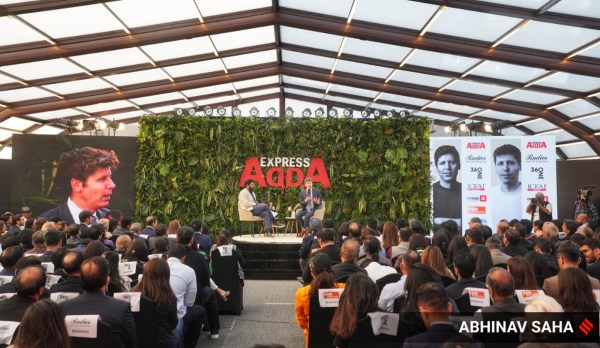 Altman is in India to attend the India-AI Impact Summit, where his company has announced a number of partnerships. (Express Photo by Abhinav Saha)
Responding to a question on how how the world may respond to China’s strengths in AI, Altman said that Beijing led in areas like manufacturing, robotics, electric motors, and magnets as well as its energy infrastructure but there are some aspects that the US is stronger in.
Sam Altman: The first thing I admire about Google is Demis (Hassabis)
Saying that his preferred AI service to look up information would be Google’s Gemini – in case he was unable to use ChatGPT – Altman acknowledged the role that AI scientists like Google DeepMind’s Demis Hassabis have played in research even though the software giant was “out of it” when ChatGPT was first publicly launched in 2022. In 2024, Hassabis was jointly awarded the Nobel Prize in Chemistry for AI research contributions for protein structure prediction.
“…the first thing I admire about Google is Demis (Hassabis) and the Google team that started working on AI before anyone else in the modern era, with a lot of conviction. Without their inspiration, we certainly wouldn’t be here… Second, and more recently, is their relentless focus and execution, ability to really scale models…” Altman said.
.