Growth estimates realistic, implementation to make capex work is our government’s strong point, Prime Minister himself monitors last mile of projects, says Finance Minister Nirmala Sitharaman in an interview to Aanchal Magazine, Liz Mathew, Sandeep Singh & Anil Sasi
The Budget projects a nominal GDP growth of 10%, implicit in it is also the inflation expectation. So are you being conservative even in the growth estimates?
No, I think I have been realistic in the way in which I’ve assessed what kind of growth (rates) are possible. It’s not conservative … for every one of my budget I’m accused of being very conservative and I keep telling that I take a very realistic call. We are able to also achieve each one of the targets. We’ve not overshot nor we’ve been conservative. Even this year, it was very realistic.
What is still holding back the private sector and how do you see it going forward?
‘Still holding back’, should be calibrated because there is a clear sign that one is able to see that they are coming out. They are investing, some of the investments which were invested in passive-income earning rather than investment with risk and producing and expanding capacities. That is now moving out of the passive mode to investments in expanding capacities or setting up new businesses. Interestingly, they probably are moving towards greater partnership with people who are in the newer, frontier sectors and — this is a bit too early but I’m still saying — probably less on the usual core manufacturing, old industries, which are core industries as well, whether it’s sand and steel and so on. So, they are moving, signs are there that they are coming forward.
You have continued with higher capex. But implementation remains a challenge…
Implementation is, in fact, one of the big, strong points of this government. The last mile is monitored even by the Prime Minister himself in his PRAGATI meetings. Once in a month, on a Wednesday, he groups up issues and brings the district magistrate or collector on board and asks them: what’s stopping, what is it which is making it slow? And then asks them if there is anything that you want from our PMO side? Do you want me to do in Delhi? To that extent the monitoring is happening for the last mile. Overall, reaching out to the last (mile) and delivering is a signature point of this government. So, implementation is not the issue.
Story continues below this ad
Finance Minister Nirmala Sitharaman
So what is the problem?
There can be states which are a bit laidback. States which are politically finding it not prudent for them to go along with the scheme because the benefit might go to Modi ji than themselves. These kinds of obstructions are there.
An industrialist recently said the next gen is more into managing family offices and not taking risk.
I’m not sure I’ll put the argument completely on the next generation. I’m sure the next generation is interested and they are also looking for avenues. They’re doing it in their own time but as I said earlier, the passive income attraction is probably receding and people are getting to come in to invest.
India needs solutions. You need tech, innovation to solve day-to-day problems faced by the citizens. And for giving solutions, do we have enough people who can deal with it and get it applied for such situations? We are taking that route while addressing labour-intensive sectors
Story continues below this ad
How concerned are you about global capital flows? In the Budget, you did relax investment limits for Persons Residing Outside India.
There is a narrative that net inflow has reduced. For that, countries like Norway, Canada are showing keen interest for their pension funds and their larger sovereign funds to come here. But there are some in North America — big fund managers — who wait and watch to see which way the trend moves, if I can say that, and then they take a call. And I’ll be open in saying this that since the call between the US President and our Prime Minister, I get the feeling that is why the stock market in India, and particularly, the rupee has covered some lost ground.
You refer to PROI decision in the Budget, I’ll equally refer to you the Economic Survey which said that despite all your fundamentals being strong, the rupee unfortunately faces the global uncertainty where fund flows don’t seem to depend on these considerations anymore. All numbers are fine, rating upgrades happened, not by one but several agencies — so you expect the funds to flow this way. But it’s clear from what’s happening — that they’re waiting for some other signal from somewhere else. My observation post this call between the Prime Minister and (the US) President is that there should be a change in the direction of where the funds will go. Surely I expect it to flow towards India.
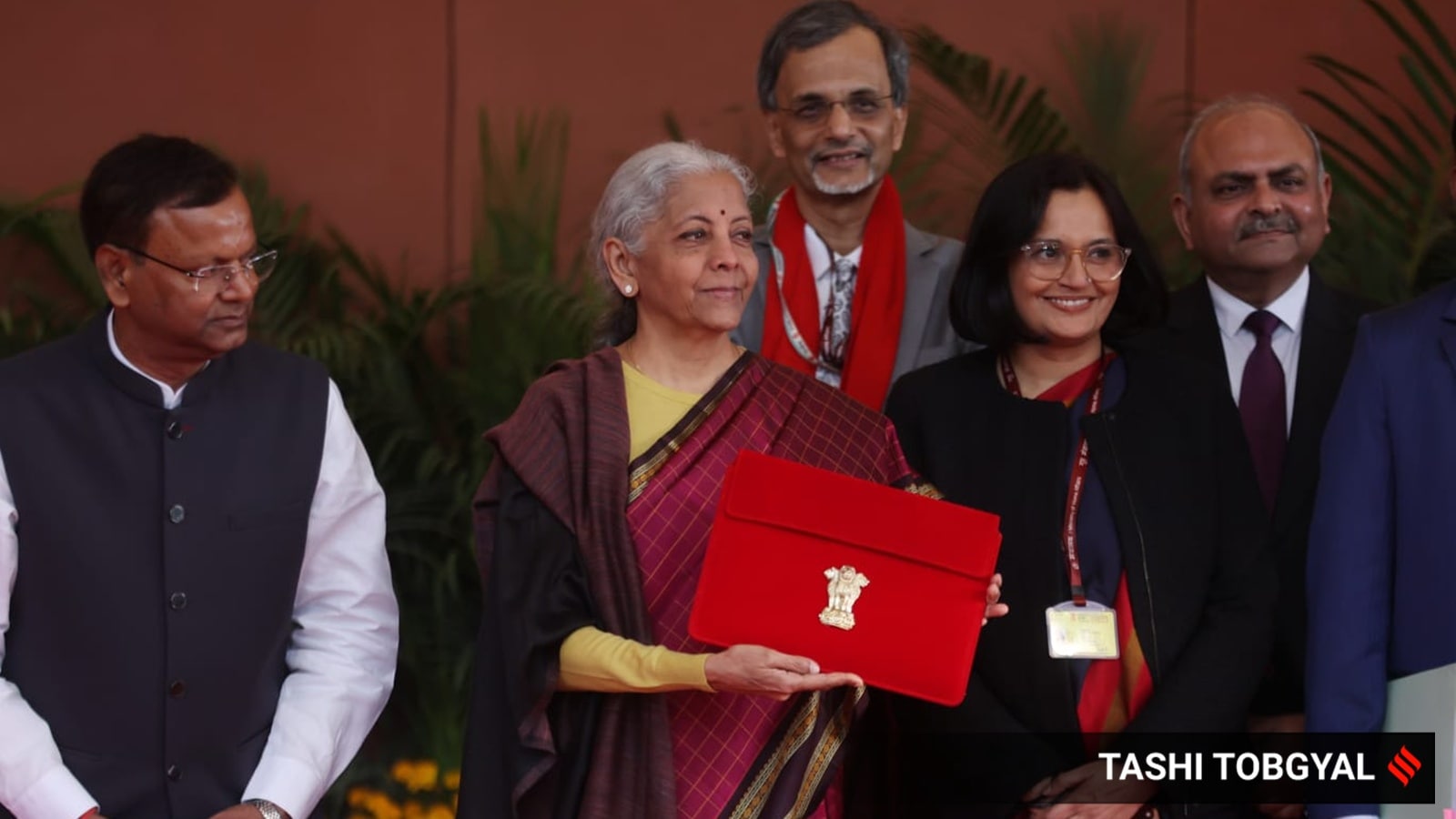 Union Minister for Finance Nirmala Sitharaman poses with her team for a photo op before leaving to present the Budget in New Delhi on Sunday. (Express Photo by Tashi Tobgyal)
Your trip to Norway and Canada, is it linked to this pitch?
Story continues below this ad
Yes, they themselves have invited me and I will be going.
Do you think there was an overhang of what some said a deterioration in the India-US relations?
Maybe a reason. May not be the only reason but maybe a reason.
Anthropic’s new AI tool led to a big selloff in the Indian IT companies. Is this a bigger risk that listed companies face with one invention in one market by one company?
Story continues below this ad
I don’t think it is that granular. But it is and several others are influenced by larger strategic considerations, not just commercial considerations.
Lot of data is collected by the AgriStack — they’ve done very well in having a complete set of digital instruments. The data that we have now is yet raw, it has to talk to each other — the portals. But Digital AgriStack is the next UPI, you can take it
On Wednesday, the Competition Commission of India ordered an investigation into abuse of dominance by IndiGo. With just a couple of airlines in the market, a regulatory change can create such a mess.
That regulatory change was not unilateral.
It was for all…
Yes, it was for all after due considerations and consultations. We will have to put it in context.
 Finance Minister Nirmala Sitharaman
Are you concerned that few companies have cornered big chunks of the market in very pivotal sectors such as cement and infrastructure sectors?
Story continues below this ad
The Competition Commission is surely very seriously looking at all this. It has powers to suo motu take up an issue. It doesn’t have to wait for somebody to come and complain. If there are practices which are indicative of monopoly or indicative of collusion, the Competition Commission is well within its right to investigate, get a report done, and act on it. That’s what they’re doing.
Has there been some internal deliberations on this commitment on imports between the US and India?
First, what the Prime Minister said was related to the tariff coming down to 18%. Nothing else was said. Only when the agreement, as and when it happens, and their details come out, will we know anything at all about it.
Is AI being seen as a threat to employment? The Budget did give a push towards labour-intensive sectors termed as AI-immune.
Story continues below this ad
See India needs solutions. It’s not only solutions for the youth in the name of jobs. You need technology, need innovation to solve day-to-day problems which are faced by the citizens. Using AI, for instance, we want to focus on solving problems. Now if we look at AI displacing people from work alone, you’ll be obsessed in that rather than looking at — is it giving solutions? And for giving solutions, do we have enough people who can deal with it and get it applied for such situations? We are taking that route.
There has been a lot of focus on skilling over the last few years. But where’s the constraint coming?
Constraint comes in standardising them. When you say standardising — it can be different places as giving AI-based training or any other skilling for different items and requirements. In some places you want people who are capable of using AI in agriculture, in some other places, you want AI only for buildings or construction. You want AI to improve productivity in tool rooms and so on. So, you’re looking at a situation where you want people to be trained even in AI. So, when you talk of skilling, it’s not one thing, it has so many different components. When I talk of standards, I’m talking about standard within this, quality training and standard within this.
What is the agenda of the high-level committee on banking?
Story continues below this ad
It’s about the financial sector. It’s about the banking sector as a whole. Whatever they want to say, they can because the terms of reference also got to be made. They’ve not yet been made. But that doesn’t mean that I’m not going to continue with what has been approved by the Cabinet already in the banking sector reforms, including disinvestment.
How long can you continue the heavy lifting on capex? You mentioned private sector is investing in some sectors.
At the moment we are looking at sustaining growth and therefore we will have to do it, so we are doing it. That will be our primary object — sustaining growth. So, we’ll have to. I can’t say I’ll do it as long as it takes. Because that’s not singularly my decision, it has to be the government’s cabinet’s decision.
You announced an infrastructure risk fund. Is that a reason why private sector is not coming in?
See, when you’re looking at small, medium sized enterprises, their risk is not just obtaining the money from the bank. Their risk is, let us say, one MSME, which is doing very well, it’s also exporting with its existing setup, but it increasingly realises that it would do lots more if it brought in robots or if it brought in AI-driven efficiencies. For investing in them, they don’t have the money. We need to support them. So the fund is required for upgrading these kinds of requirements within an existing flourishing industry. It can also mean a company is doing very well but its human skilling needs upgrading, at one go, all the employees (need) to be upskilled.
Another (example), there is a medium-sized industry which has everything in it to become big. Last year, we cleared that fear that if I grow and become outside of MSME, I lose all the benefits. We gave them the assurance that the benefits will continue. By these kind of funds and making champions out of them, you are assuring them that we are not cringing on the money element. You want more funds, you take it, but grow big is what we want to convey. Grow modern is what we want to convey, use technology is what we want to convey. So if you’re saying all this, are we backing it with money, if required? Yes, we are backing it with money, if required. So it can be for any of these.
You have set an ambitious target for reduction of Centre’s debt-to-GDP ratio. Also, what are you doing about high state debt impinging on your borrowing costs?
No, but with the states I must say I have been nudging them to look at their finances. I’m not saying I will deny you the borrowing right. You borrow, but within your FRBM limits. If there are state public enterprises, which have revenue sources and they are borrowing for expanding or something else, I can agree. But if you’re making welfare boards, which have no revenue source of their own to borrow for you, and for that you pledge what is supposed to be a budgetary provision to them (say tax from excise duty you take for the next 5 years), that cannot be allowed. For five states, which had gone well beyond the 3% and which made boards which had no revenue of their own to borrow from outside, we said you please pay that back. We allowed them to spread it over 3-4 years, and even relaxed it when they cited it was an election year.
Article 293 in the Constitution gives me the power to monitor the debt of states. Kerala went to the court, but the court said go sit and sort it out (with the Centre).
I have also taken positive steps, not with just one state but with many. And in fact one of the state chief ministers, from the opposition, took up the offer, to bring down high cost debt, and lower the interest burden. He was gracious and said in the Assembly that the finance minister said this and after that we had our team go, our debt burden has come down.
How do you address competitive populism?
If your state budget has that cushion, go ahead giving your freebie. Don’t do it with borrowed money because it becomes intergenerational. You do it, you take the loan, give the freebie, you enjoy your 5 years and you go home. Who pays it back? This generation and the next. Do we have the right to go on burdening?
Subsidies at Rs 4 lakh crore have remained high for three years, and are almost one per cent of the GDP. What is holding you back from pushing reform?
Technology compatibility is a thing in work-in-progress. We need technology to not only give us doubly verified data about the farmers and then data about the quantum of fertilizer required for a particular crop on a particular extent of land. The fertiliser used can be urea, DAP, or liquid nano. We need a data bank, based on each farmer’s profile (the land profile). That’s when you know what will be the quantum of urea/ DAP needed. I need all this granular data.
Your own capacity to produce fertilisers is very limited. Each time I go to the market to bid for a tender to buy fertiliser, the price fluctuates hugely. So other than the grassroot problem of you not being able to give him what he wants, be it urea or DAP, I should apportion the money in advance.
Now this has to not just be for this year’s Kharif, it has to be in advance for the next year’s Rabi. Lot of data is collected by the AgriStack — they’ve done very well in having a complete set of digital instruments. Digital AgriStack is one of next UPI, you can take it. So if that is one thing, you also have data through which you are now authenticating a kisan through his Aadhaar, KCC card. And when you look at Aadhaar and KCC you know the farmer’s profile (big or small). That data will have to talk to this data in the AgriStack. It is only when these two can talk to each other and I’m able to get the answer of, how much quantity will they reasonably require. In the meanwhile I should have technology to see how these urea bags are identified and traced till the last — who is actually buying it? A kisan, who normally has no money to buy seeds, he has has to be given that little extra amount. That’s why he Kisan Samman Nidhi. He is not going to buy where he needs one bag, five bags. So somebody else is buying in his name. So I need to have a tracking system of where these bags go.
The data that we have now is yet raw, it has to talk to each other — the portals. Only then will I know. Till then yes, the subsidy goes to the company because a farmer with his Kisan credit card goes and buys it.
But till I get these things done, talking to each other and clearing up the duplication, clearing up the confusion and traceability of my urea, till all that is done, I can’t even take a call.
.