As markets swung between optimism and uncertainty over the past year, mutual fund strategies that spread bets across asset classes emerged clear winners. Multi-asset mutual fund schemes delivered superior returns compared with both equity-focused and balanced funds, benefiting significantly from robust gains in commodity prices, particularly those of gold and silver.
By design, multi-asset schemes invest across a minimum of three asset classes — typically equity, debt, and commodities — with at least 10 per cent allocated to each.
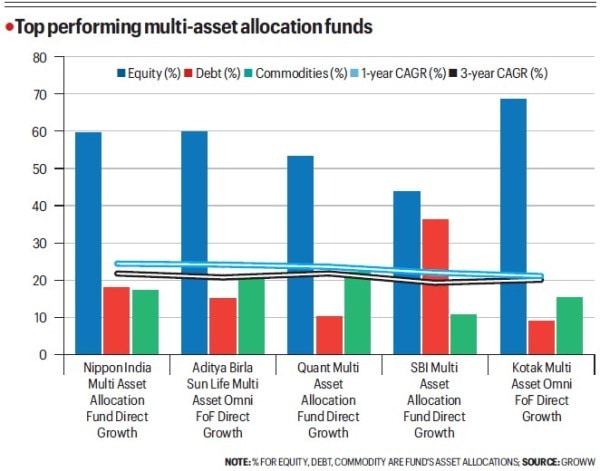
The 10 top-performing multi-asset funds have grown, on average, at a compounded annual growth rate (CAGR) of 20.26 per cent over the past year and 21.01 per cent over a three-year period, data compiled by The Indian Express showed. In comparison, the top 10 equity-focused funds have grown at a CAGR of 16.62 per cent over the past year, with only seven of them posting double-digit returns and four providing a return higher than the average of the 10 multi-asset funds considered. This is at a time when the volatile Sensex rose 9 per cent in 2025.
On the other hand, the top 10 hybrid or more balanced funds which have provided the highest return over a three-year period delivered a return of just around 9 per cent CAGR over the past year, with only two of them giving double-digit returns and only one outperforming any of the multi-asset funds considered (ICICI Prudential Equity & Debt Fund Direct Growth returned 14.96 per cent, outpacing UTI Multi Asset Allocation Fund Direct Growth’s return of 14.54 per cent).
For those favouring no risk: the interest rate on State Bank of India’s one-year term deposit is currently 6.25 per cent, with the Reserve Bank of India having slashed the repo rate by 125 basis points to 5.25 per cent in 2025.
The diversified structure of multi-asset funds allows fund managers to rebalance portfolios in response to changing market conditions, helping smooth returns and reduce overall risk. As a result, multi-asset funds have been better positioned to capture upside opportunities across asset classes while cushioning portfolios against downturns in any single segment. The rally in precious metals offered a crucial diversification advantage to multi-asset funds at a time when equity markets were volatile and debt returns remained relatively modest.
The popularity of multi-asset funds is also visible in data provided by the Association of Mutual Funds in India (AMFI), where these funds saw among the highest net inflows in December (Rs 7,425.98 crore), with only schemes focusing on exchange-traded funds (ETFs) beating them (Rs 24,846.18 crore). A similar trend was also seen in November. In December 2024, multi-asset funds had seen net inflows of just Rs 2,574.72 crore, outpaced by mid-, small-cap, sectoral, and flexi-cap funds, among others.
Story continues below this ad
The outperformance of multi-asset funds is primarily due to their investments in gold and silver, which have been the most in-demand assets over the past year. Gold surged nearly 76 per cent in that period, while silver skyrocketed 168 per cent, according to Multi Commodity Exchange of India (MCX) data. This rise was led by safe-haven demand amid uncertain global geopolitical conditions and weakening of the US dollar. In comparison, the benchmark Nifty 50 and Sensex rose only around 8-10 per cent in that time.
Of the top 10 multi-asset funds, the best performers have a significant portion allocated to commodities. For example, the Nippon India Multi Asset Allocation Fund Direct Growth fund, which delivered an over 25 per cent return over a year, has 17 per cent of its portfolio allocated to commodities. The Aditya Birla Sun Life Multi Asset Omni FoF Direct Growth scheme has provided 24 per cent returns over the past year, and has 22 per cent of its assets in commodities. While the schemes do not disclose the exact breakdown of their commodity investments, both heavily invest in “gold ETFs and any other mode of investment in commodities”, according to their websites.
“People should look at multi-asset funds as an avenue to maximise their risk-adjusted returns,” said Devender Singhal, fund manager at Kotak Mahindra Asset Management Company. “Having multiple asset classes reduces your market risk substantially. The recent global volatility on both political and economic front has led to sharp outperformance of precious metals, thus helping multi-asset funds outperform the equity market last year.”
“…they (multi-asset funds) may have another good year, but outperformance to equity depends on factors such as a US trade deal, monsoons, and corporate earnings. If all these are lacklustre, multi asset funds might outperform again,” he added.
Story continues below this ad
Among the 10 equity-focused funds referred to, the four that have delivered an over 20.26 per cent return (average return of the 10 multi-asset funds) over the past year are Edelweiss US Technology Equity FoF Direct Growth (24 per cent), Motilal Oswal BSE Enhanced Value Index Fund Direct Growth (27 per cent), ICICI Prudential Transportation and Logistics Fund Direct Growth (22 per cent), and ICICI Prudential Nifty Auto Index Fund Direct Growth (21 per cent). Of these, the scheme by Edelweiss is based on a US-based JP Morgan fund and thus does not depend on the domestic equity market.
Out of 10 hybrid funds, only ICICI Prudential Equity & Debt Fund Direct Growth fund (15 per cent) and SBI Balanced Advantage Fund Direct Growth fund (11 per cent) have delivered double-digit returns over the past year. The 10 hybrid funds considered have delivered a return of 16.45 per cent CAGR in the three-year period.
.