India Thursday signed a free trade agreement (FTA) with Oman, the second trade deal with a Gulf Cooperation Council (GCC) country after the UAE, in an effort to expand market access for its exporters in the West Asian market at a time when steep tariffs in the US market are hurting trade and investments.
Prime Minister Narendra Modi, who met Oman Sultan Haitham bin Tarik in Muscat, told the India-Oman Business Forum: “Today we are taking a historic decision, the echoes of which will be heard for many decades to come. The Comprehensive Economic Partnership Agreement, or CEPA, will infuse our partnership with new confidence and energy in the 21st century. This is the blueprint for our shared future. It will give new momentum to our trade, new confidence to investment, and open new doors of opportunity in every sector.”

“CEPA will create many new opportunities for growth, innovation and employment for our youth. Your role is crucial in ensuring that this agreement moves from paper to performance. Because only when policy and enterprise work together does a partnership create new history,” he said.
Story continues below this ad
Under the deal, Oman has offered zero-duty access on 98 per cent of its tariff lines that could result in $2 billion worth of exports in the near term, according to official estimates, benefitting gems and jewellery, textiles, leather, footwear, sports goods, plastics, furniture, agricultural products and engineering products, among others.
India, on its part, has liberalised tariffs on 77.79 per cent of its total tariff lines, protecting sensitive sectors such as agricultural products including dairy, tea, coffee, rubber, and tobacco products; gold and silver bullion, and jewellery. As part of the services sector deal, Oman has increased the quota for Intra-Corporate Transferees from 20 per cent to 50 per cent.
Story continues below this ad
Commerce Minister Piyush Goyal said the pact between the two countries was a defining milestone in the bilateral relationship and the first agreement for Oman in nearly two decades. He said the two countries can cooperate on energy transition, including green hydrogen, renewable energy and infrastructure development.
The Ministry of Commerce and Industry said, “For the first time, Oman has offered wide-ranging commitments under Mode 4, including a notable increase in the quota for Intra-Corporate Transferees from 20 per cent to 50 per cent, together with a longer permitted duration of stay for Contractual Service Suppliers, extended from the existing 90 days to two years, with the possibility of a further two-year extension.”
According to the Ministry, the agreement also provides for more liberal entry and stay conditions for skilled professionals in key sectors such as accountancy, taxation, architecture, medical and allied services, thereby supporting deeper and more seamless professional engagement.
Story continues below this ad
“The CEPA provides for 100 per cent Foreign Direct Investment by Indian companies in major services sectors in Oman. Both sides have agreed to hold future discussions on social security coordination once Oman’s contributory social security system is implemented,” it stated.
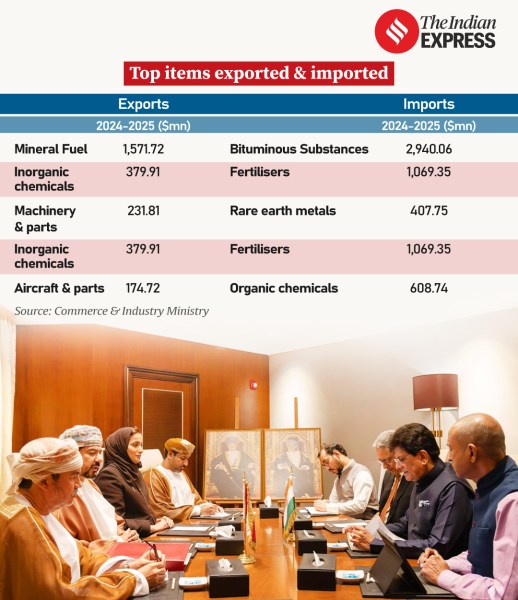
Oman’s total annual imports are around $40 billion, but nearly two-thirds of its imports are machinery goods where India could gain market access. Indian exports, largely driven by machinery and parts exports, have doubled in the last five years from $2 billion to $6 billion. New Delhi’s top exports include machinery, aircraft, rice, iron and steel articles, beauty and personal care products and ceramic products.
The CEPA, according to the government, is expected to have three outcomes: “Strengthen and further develop closer economic and commercial integration, increase trade between the two countries by reducing trade barriers and creating a stable framework, and unlock opportunities in all major sectors of the economy, enhance economic growth, create jobs and boost investment flows between both countries.”
Story continues below this ad
Ajay Srivastava, former trade officer and head of think tank Global Trade Research Initiative (GTRI), said while more than 80 per cent of Indian goods already enter Oman at an average tariff of around 5 per cent, duties on some items run as high as 100 per cent.
“Their elimination under the CEPA is expected to improve price competitiveness for Indian exporters, though growth prospects are tempered by the size of Oman’s domestic market,” he said.
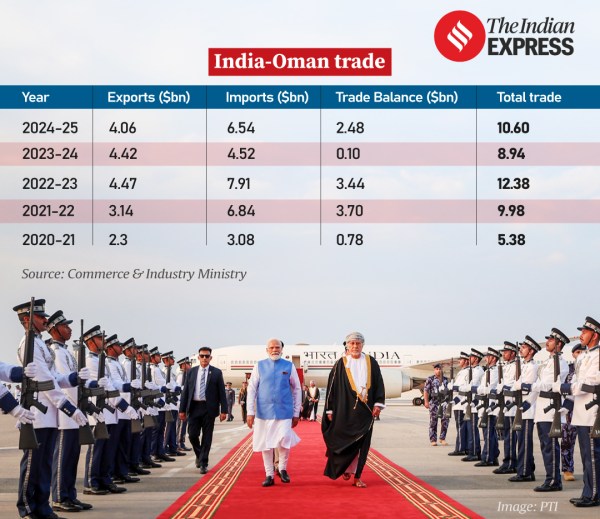
Oman’s gains are concentrated in energy and industrial inputs. India has offered tariff liberalisation on about 78 per cent of its tariff lines, largely through tariff-rate quotas to protect sensitive sectors. India imported roughly $6.6 billion of goods from Oman in fiscal 2025, dominated by crude oil, liquefied natural gas and fertilisers, alongside chemical inputs such as methanol and ammonia, Srivastava said.
Story continues below this ad
S C Ralhan, president of Federation of Indian Export Organisations (FIEO), said Oman’s strategic location makes it a vital gateway to the Gulf and Africa, and the CEPA will enable Indian exporters to integrate more effectively into regional value chains, diversify markets, and expand India’s export footprint.
“With bilateral trade already exceeding $10 billion, the agreement provides a strong platform for accelerated growth in merchandise trade. The CEPA also delivers ambitious and forward-looking commitments in services, covering 127 sub-sectors including IT and computer-related services, business and professional services, R&D, education, health, and audio-visual services, unlocking high-value opportunities for Indian service providers,” he said.
India’s footprint in West Asia
With Oman offering zero-duty access on 98% of its tariff lines, the pact is likely to improve competitiveness for Indian industrial exports. This is India’s second pact with a Gulf Cooperation Council member. It entered into a CEPA with the UAE in 2022. Other members of the GCC are Bahrain, Kuwait, Qatar and Saudi Arabia.
Modi reached Oman Wednesday after visiting Jordan and Ethiopia. Talks for the CEPA formally began in November 2023 and negotiations concluded this year.
Story continues below this ad
Over 6,000 India-Oman joint ventures are present in Oman. The Oman-India Joint Investment Fund (OIJIF), a 50-50 JV between the State Bank of India and Oman Investment Authority, was set up as a special purpose vehicle (SPV) to invest in India. It has fully invested $320 million and currently the third tranche of $300 million is under implementation.
The Oman India Fertilizer Company(OMIFCO) established at Sur is a $969-m JV between Oman Oil Company, IFFCO, and KRIBHCO.
Besides CEPA, the two sides signed five pacts on maritime heritage and museums, agriculture, higher education, food innovation and maritime cooperation.
Sultan Haitham bin Tarik conferred upon Prime Minister Modi the Order of Oman award for his “exceptional contribution to India-Oman ties and his visionary leadership”, a PMO statement said.
.